Barrels escape
The Barrels escape is the ingenious and desperate plan by which Bilbo Baggins liberates the twelve imprisoned dwarves from the Elvenking's Halls and flees the dark heart of Mirkwood, a turning point that transforms him from a reluctant tagalong into the expedition's decisive leader and brings the company at last to the shores of the Long Lake.
Origins and Context
After the dwarves were captured by the Wood-elves and Thorin Oakenshield was separately imprisoned, Bilbo spent weeks lurking invisibly in the Elvenking's palace, surviving by stealing food and learning the layout. He discovered that a stream flowed under the lowest regions of the palace, joining the Forest River further east, and that a water-gate with a portcullis allowed barrels to be floated out. The empty barrels were cast through trapdoors into the stream, bobbing along until they were collected near the eastern edge of Mirkwood and floated back to Lake-town. This water-gate became the foundation of his plan.
The Plan and Its Execution
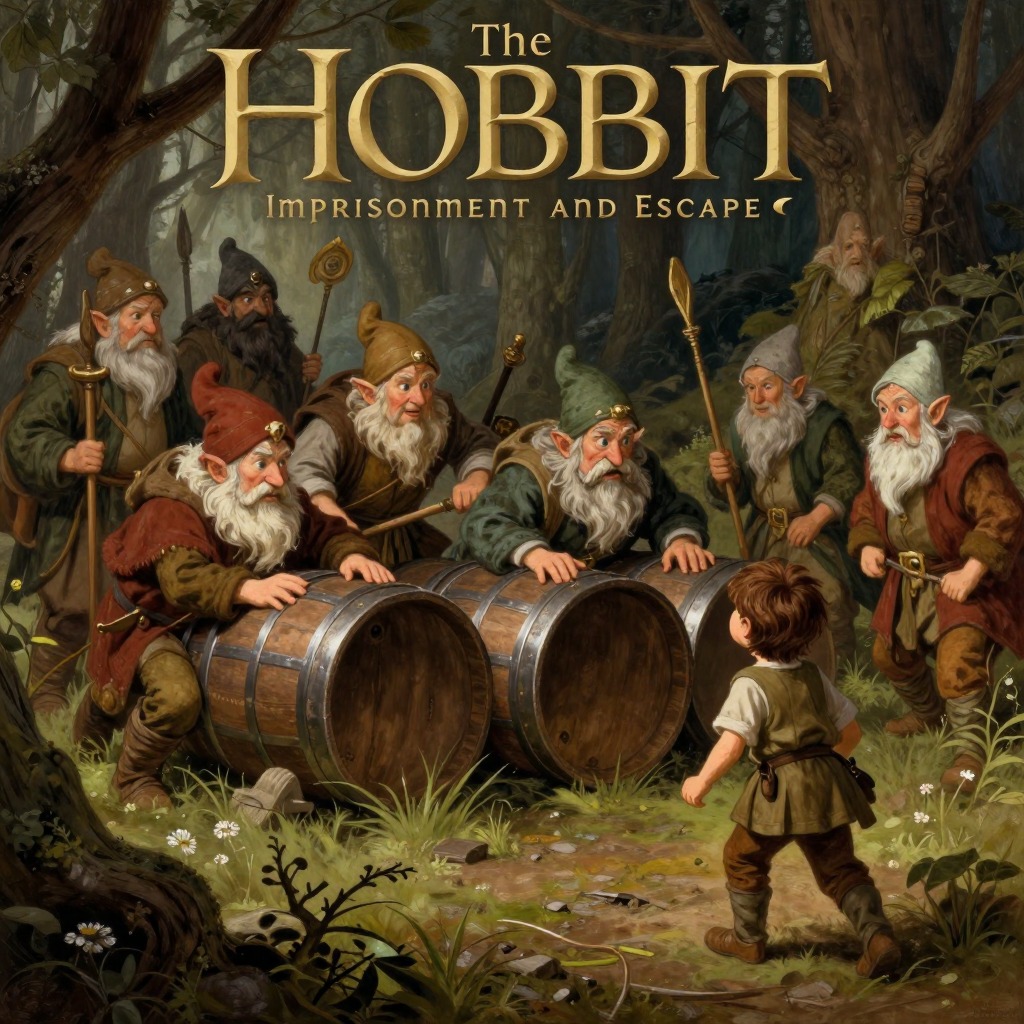
Bilbo stole the keys from the chief guard after the guard and the butler, Galion, fell into a deep sleep from drinking the potent wine of Dorwinion. He unlocked each dwarf's cell, leading them through the dark passages to the cellars where the barrels stood. The dwarves initially grumbled, calling the plan mad and fearing they would be bruised, battered, and drowned, but Bilbo insisted it was their only chance. They found thirteen barrels with room enough for a dwarf each, and Bilbo packed them with straw for comfort, though Thorin turned and twisted in his tub, grumbling like a large dog in a small kennel, and Balin complained of stifling even before his lid was on. The elves, returning from a feast, rolled the barrels to the opening, singing as they sent them down into the cold water, unaware that twelve of the tubs contained dwarves.
Bilbo's Desperate Ride
Bilbo had not planned for himself: there was no barrel left for him, and no one to pack him in. As the last barrel was rolled to the doors, he caught hold of it and was pushed over the edge, falling into the cold dark water with the barrel on top of him. He came up spluttering and clung to the wood like a rat, but could not scramble on top; the barrel rolled and ducked him under again. He floated through the dark tunnel, icy and alone, until the current carried several barrels close ashore. There he scrambled up the side of his barrel and lay on top, spread out to keep balance, riding like a round-bellied pony that was always thinking of rolling on the grass. The river opened wide, joined by the main water of the Forest River, and the barrels were swept into a bay with a shingly shore, where they ran aground.
Aftermath and Significance
Bilbo waded ashore, sneaked into a village, and stole a loaf, a leather bottle of wine, and a pie. The next morning he climbed back onto the raft of barrels as it was poled off down the stream toward Lake-town. The escape brought the company out of Mirkwood and into the open lands, where Bilbo saw the Lonely Mountain for the first time, looming dark and threatening. The plan succeeded because of Bilbo's resourcefulness, his use of the ring, and his willingness to take the same risk as the dwarves, cementing his role as the true leader of the adventure. The episode also introduced the route that would lead to the confrontation with Smaug and the eventual battle for the treasure.